 By Marcus Bell
Editor-in-Chief
Dolce Gabbana Accessories: Compare Shipping & Rates
The issue at hand isn't "which agent is definitely cheaper." It's about giving the same Dolce & Gabbana item and the same package conditions to different agents to compare, avoiding mixing item price, service fees, payment fees, packaging fees, international shipping, and exchange rate differences into one number. Once you've completed the record, you can decide to continue with the order, ask the agent for more details, or hold off on payment. 🧾 This article's verification date: October 21, 20
Editor score 4.2 / 5
The issue at hand isn't "which agent is definitely cheaper." It's about giving the same Dolce & Gabbana item and the same package conditions to different agents to compare, avoiding mixing item price, service fees, payment fees, packaging fees, international shipping, and exchange rate differences into one number. Once you've completed the record, you can decide to continue with the order, ask the agent for more details, or hold off on payment. 🧾
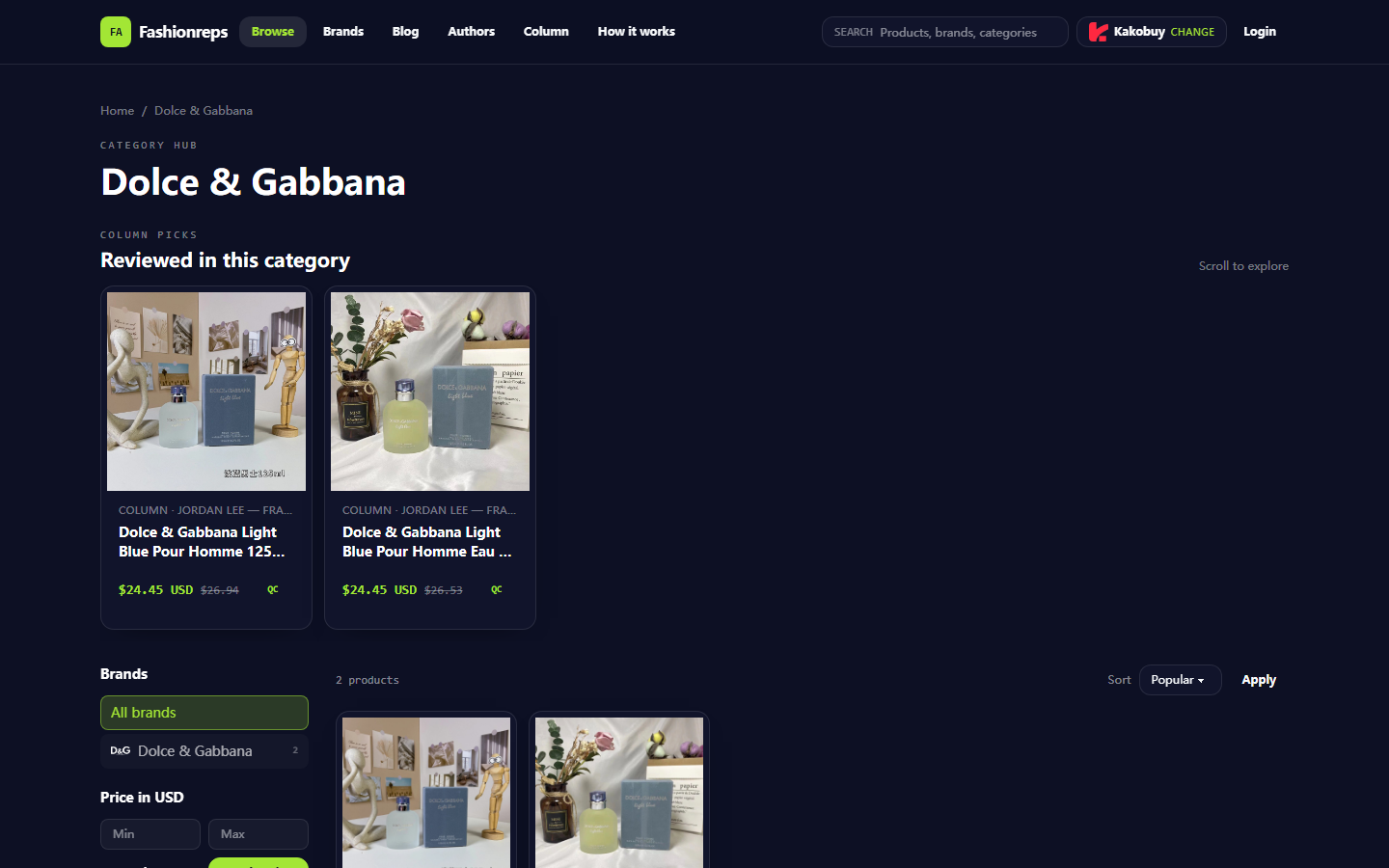
This article's verification date: October 21, 2026. The currently visible Fashionreps brand page shows the Dolce & Gabbana category and item entries, and provides multiple shopping agent options; the page sample clearly shows perfume items, which is not enough to prove the stock, size, weight, packaging, or international shipping for a specific accessory. Therefore, this article does not use the perfume page's reference price as an accessory quote, nor does it fill in shipping values not confirmed by a calculator or official page.

Defining the Single Decision for dolce gabbana Accessory Same-Package Comparison
First, clearly state the sole question for this comparison: For the exact same Dolce & Gabbana accessory, with the same destination, quantity, packaging requirements, and billing time, which agent provides a clearer total cost and a more acceptable risk?
Here, "same package" doesn't mean forcing different quotes together, but requiring each agent to use the same set of inputs:
- The same item page or item identification information.
- The same quantity and color, size, or specifications.
- The same destination country, region, and postal code.
- The same packaging requirements, such as keep original packaging, remove outer box, or basic reinforcement only.
- The same declared value and compliance requirements.
- The same comparison time to avoid misjudgment from exchange rate and route price changes.
If an agent only says "calculate after arrival at warehouse," you cannot directly rank it against an agent that already shows a complete route quote. It should be marked as "pending evidence" rather than defaulting to cheap or expensive. ⚖️
Fix Target Site Visible Item, Quantity, Currency, and Query Time
Before publishing, you should confirm the item name, category, and page status from Fashionreps' visible item entry. The provided page summary only confirms that the Dolce & Gabbana category has visible item samples, not the real-time stock, seller, full specifications, or current transaction price of the target accessory.
Therefore, when recording, separate "item page visible facts" from "agent-side pending facts":
- Item page visible facts: brand, item name, category, reference currency displayed on the page, and page visible time.
- Agent-side pending facts: actual item price, stock, seller, warehouse entry status, actual weight, dimensions, packaging fee, and route quote.
- User-filled facts: destination country, region, postal code, quantity, payment currency, and acceptable delivery time.
This comparison requires at least the following fixed fields: item currency, agent quote currency, payment account settlement currency, destination country or region, postal code, query time, item quantity, and whether the package includes other items. If any of these is missing, you can only collect information, not declare any agent's total cost lowest. 📌
Unify Destination, Package Dimensions, Weight, and Item Category
International shipping is usually affected by chargeable weight, package dimensions, route restrictions, destination, and item category. For accessories, you cannot infer weight from the item name alone, nor treat the single item's net weight as the final package chargeable weight.
Require each agent to provide or confirm in the same order:
- Actual weight after warehouse entry.
- Length, width, and height after packaging.
- Chargeable weight actually used between actual and volumetric weight.
- Whether the item category triggers liquid, magnetic, battery, fragile, or brand-related restrictions.
- Whether to keep original box, tags, dust bag, and other packaging.
- Available routes, estimated transit time, tracking range, and restrictions.
If the target accessory contains perfume, spray, liquid, or other restricted ingredients, you cannot apply ordinary clothing accessory routes just because the page belongs to the same brand. The current visible page sample is a perfume item, which shows the item category must be confirmed separately; perfume shipping conditions cannot represent leather goods, jewelry, eyewear, or other accessories. 🚚
How to Record Item Amount, Payment Fee, Service Fee, and Packaging Separately
When comparing, don't just record "item plus shipping." You should at least break the costs into six layers:
- Item price: the amount and currency confirmed by the agent or seller.
- Agent service fee: purchasing, warehousing, inspection, or other clearly charged service fees.
- Payment fee: fees from bank cards, third-party payments, or currency conversion.
- Packaging fee: basic packaging, reinforcement, box removal, keep original packaging, etc.
- International shipping: specific route, chargeable weight, destination, and quote currency.
- Taxes and destination country fees: including possible import duties, customs clearance, or delivery surcharges; if not confirmed, do not write as included.
For each item, save the original page, quote sheet, calculator result, or customer service confirmation. If a quote only shows a total amount, ask the agent to break it down; otherwise, list it as "total price to be explained."
| Verification Item | Evidence to Record | Handling if Missing |
|---|---|---|
| Item price | Item identification, quote currency, quote time | Don't treat page reference price as final price |
| Service and payment | Rate, fixed fee, or charge description | Mark as unconfirmed, don't self-estimate |
| Packaging | Packaging options, size changes, keep original box or not | Re-inquire after packaging quote |
| International shipping | Route, chargeable weight, destination, query time | Don't directly compare with other agents' complete quotes |
| Taxes | Prepaid or not, additional charge or not, applicable countries and conditions | Treat as not included, and prompt destination country confirmation |
How to Save Exchange Rate and Fee Evidence for 2 to 3 Agents
Choosing two or three agents is enough for a preliminary comparison. The current page summary shows optional agent entries but no complete quote, exchange rate, payment fee, or international shipping for the target accessory, so you cannot judge which is cheaper.
Save three types of evidence for each agent:
- The item or warehouse quote displayed on the agent page.
- The exchange rate used by the agent, update time, and direction, e.g., local currency to quote currency.
- The fees, exchange surcharges, or final debit currency shown on the payment page.
When converting, first unify to the same comparison currency, then separately list "agent displayed total" and "estimated amount converted at unified exchange rate." Don't disguise estimated amounts as actual debits. If the agent uses dynamic exchange rates, record the query time; if the rate is hidden on the settlement page, save the visible record of the settlement page, and don't use public mid-market rates to replace the actual debit rate.
Suggested calculation order:
- Agent total cost = item price + service fee + payment fee + packaging fee + international shipping + other clearly specified fees.
- Unified currency estimated amount = sum of confirmed amounts converted at the recorded exchange rate.
- Exchange rate difference = difference between actual debit converted amount and agent quote converted amount.
If any amount or rate lacks evidence, leave it blank and write "pending confirmation." Don't fill it with averages, historical prices, or model estimates. 💱
Aligning Official Shipping Calculator Results: Route, Chargeable Weight, Transit Time, and Tax Basis
A shipping calculator has comparison value only when input conditions are exactly the same. When saving results, also record route name, destination, postal code, chargeable weight, package dimensions, item category, query time, currency, estimated transit time, and tax notes.
Focus on four checks when aligning:
- Do both agents use the same destination and postal code, not just the same country?
- Is the displayed weight actual, volumetric, or packaged chargeable weight?
- Does the route price include fuel surcharges, remote area fees, customs clearance, or final delivery?
- Are taxes prepaid, collect, possible, or not mentioned at all?
If one agent uses a tax-inclusive route and another shows only base shipping, they cannot be directly compared. If transit time is only an estimated range, don't write it as a guaranteed delivery date. Combining packages may reduce repeated first weight or some operational costs, but may increase volumetric weight, package value, and single-loss risk; splitting packages may increase fixed costs but may resolve route restrictions or reduce per-package risk. 📦
How to Convert to an Inquiry Process When Page Data Doesn't Match
When item pages, warehouse data, and shipping calculators cannot be matched one-to-one, the safest result is not to fill in a seemingly precise number, but to generate a copyable inquiry list:
- Please confirm the actual item price, stock, and seller information.
- Please confirm the actual weight after warehousing, and the length, width, and height after packaging.
- Please quote separately for keep original packaging and basic volume-reduction packaging.
- Please list available routes, chargeable weight, estimated transit time, and tracking range.
- Please explain whether service fees, payment fees, packaging fees, fuel fees, remote area fees, and possible taxes are included.
- Please provide the quote currency, exchange rate update time, and final debit currency.
- Please confirm whether there are route restrictions, customs restrictions, or return conditions for this item category.
After receiving replies, fill each agent's answers into the same evidence table. If an agent only says "subject to final system quote," keep that status until warehouse data and calculator results are readable. Don't write an unfinished inquiry as a completed cost comparison.
Final Action: Decide to Continue, Follow Up, or Pause After Completing the Same-Condition Evidence Table
After completing the evidence table, you can act on three outcomes:
- Continue: item, weight, route, exchange rate, fees, and tax basis are all clear, and total cost fits the budget.
- Follow up: only one or two data points missing, especially packaged chargeable weight, exchange rate update time, or tax range.
- Pause: item identity, stock, shipping restrictions, final payment amount, or destination compliance cannot be confirmed.
Savings must come from confirmed differences between same-condition quotes, not from page reference prices or unverified exchange rates. Combining packages may save repeated first weight or some operational costs, but may increase volumetric weight, concentrated package value, and single loss risk; splitting packages may increase fixed costs but may reduce route restrictions or per-package losses.
Those more suited to combining packages are people whose items are category-compatible, packaging dimensions controllable, route rules clear, and who can accept concentrated risk. Situations not suitable for combining include items with different shipping restrictions, overly high package value, significantly increased volume after packaging, unclear destination compliance, or agent inability to explain taxes and return responsibilities. If key data is still missing, pausing payment is safer than deciding based on an unverified low price.