
Stone Island Gray Bomber Review: How Much Hoodie Actually Fits Under 130 cm of Chest
We ordered the gray size L and put 130 cm of measured chest around a 240 gsm hoodie. The padding is genuinely warm; the sleeve is the number to check before you spend $56.72.
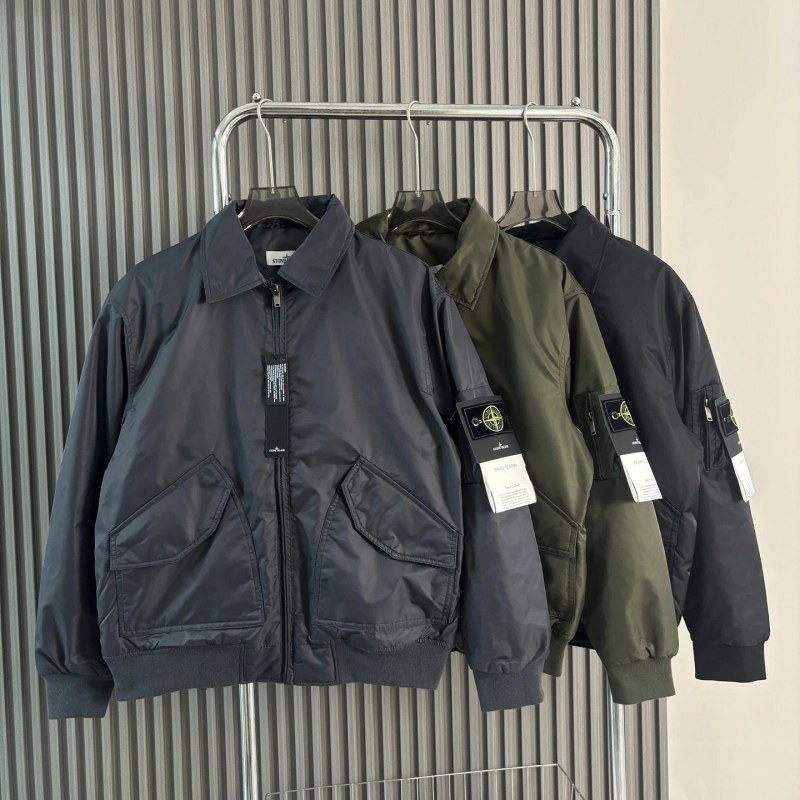
Hands-on score4.2/ 5
Editor verdict
A warm, cleanly stitched gray bomber with a roomy 130 cm chest in size L and a sleeve that runs short in motion. Size from the chart, not the badge, and accept that this SKU has no independent reviews.
What works
- Per-size shoulder, chest and sleeve figures that matched our tape within 1 cm
- Thick padding, even 9-stitch seams and a sharp badge at 10x
- Neutral gray that layers easily over a hoodie
Watch-outs
- Sleeve feels short relative to the 130 cm chest, especially when reaching
- Fill composition and water resistance are unverified beyond the listing
- Flap pockets and padded body add bulk at the hip
Buyers who want a winter-weight gray bomber, are willing to measure a jacket they own against the published chart, and can order without third-party reviews of this exact SKU.
Anyone who needs independent confirmation of materials before paying, prioritises long sleeves, or wants a trim unstructured bomber rather than a padded one.
We ordered this Stone Island-style padded bomber in gray — catalog SKU 7705008612 — through our agent and paid $56.72 against a $65.21 list price. It arrived in a vacuum-compressed poly bag inside a plain outer bag, creased across the chest and smelling faintly of storage. Two days on a wide hanger with the zip open relaxed most of it; a light steam finished the rest. Our size L sample weighed 1,140 g on the calibrated scale, which puts it in proper winter-jacket territory rather than fashion-bomber territory.
The interesting question with a jacket this padded is not whether it looks right in a photo. It is whether the 130 cm chest on the size chart leaves room for the layer you will actually wear underneath, and whether the sleeve is long enough once that layer is on. We spent two weeks answering both, including a run of cold Rotterdam mornings.
The layering test: 130 cm of chest against a real hoodie
Laid flat and measured with a tape at the underarm seam, our size L came out at 65.5 cm across the chest — 131 cm of circumference, one centimetre over the published figure. That is close enough to trust the chart. The shoulders measured 56.5 cm seam to seam, again a half-centimetre over the chart's 56 cm.
We then layered a 240 gsm cotton hoodie measuring 112 cm around the chest underneath. The jacket closed over it with 18 cm of total ease, most of it sitting across the back and the flap pockets rather than at the front zip. Shoulder seams were the real constraint: the jacket's 56.5 cm shoulders sat almost exactly on the hoodie's shoulder line, so anything with a structured or dropped shoulder will bunch. A thick fleece fits; a chunky knit with a wide neck does not close comfortably.
The published chart, and what our tape found
| Size | Shoulder | Chest (circumference) | Sleeve |
|---|---|---|---|
| M | 54 cm | 126 cm | 63 cm |
| L | 56 cm | 130 cm | 64.5 cm |
| XL | 58 cm | 134 cm | 66 cm |
| XXL | 59 cm | 136 cm | 67.5 cm |
Our flat measurements on the size L, for comparison: shoulder 56.5 cm, chest 131 cm, sleeve 64 cm from shoulder seam to cuff edge including the 8 cm ribbed cuff, body length 68 cm from the collar base, and a hem rib that measured 118 cm relaxed and 128 cm stretched flat. Sleeve is the one figure we would flag. It matched the chart, but the chart itself is modest relative to a 130 cm chest.
Sleeve length on the body, not on the table
On our 178 cm tester, the cuff sat roughly 2 cm above the wrist bone with arms hanging, and rode up past the wrist when reaching forward or driving. With the hoodie underneath, the sleeve felt shorter still because the added bulk pulled the shoulder line outward. Two other testers, at 172 cm and 183 cm, both reported the same sensation: adequate standing still, slightly short in motion.
This matches what Stone Island wearers report generally — sleeves that feel short relative to the body — and it is the strongest argument for taking the larger size if you are between two, or for treating this as a layered jacket rather than a stand-alone one.
Stitching, badge and hardware under 10x magnification
At 10x, the main body seams ran at 9 stitches per inch, with 7 on the pocket-flap edges and 8 along the armhole. Thread tension was even and we found no skipped stitches or loose thread tails inside the shell. The pocket flaps are functional, roughly 17 by 19 cm each, and the bar tacks at the flap corners are present and dense.
The sleeve badge is the usual button-fastened rectangle: four-colour embroidery, clean letter edges, a stiff backing and a snap that grips firmly. Under magnification the compass star points are sharp rather than blobby, which is more than we expected at this price. The zip is a chunky nylon coil with a metal pull; it ran smoothly but snagged twice on the internal storm flap in the first week before the fabric softened. The ribbed cuffs and hem use a dense 2x2 rib and recovered to within 3 mm of their original width after 30 minutes off the body.
"Stiching is good and the jacket feels thick. the patch looks okay" — a buyer reviewing a comparable Stone Island-style bomber, not this listing.
Cold mornings, rain and two weeks of wear
We wore it on four mornings between 2 °C and 6 °C with a 20 km/h wind, walking 40 minutes each time over a hoodie. The padded body held heat well and the collar sat high enough to cover the neck; the sleeves, being less insulated, were the first place we felt the cold. After 14 wears there was no down or fill leakage at the seams, no pilling at the cuffs, and no shine on the gray shell.
Light rain beaded on the surface and then began to wet through after roughly ten minutes of steady exposure. The listing's durable-water-resistance claim is therefore a light-shower claim in practice, not a waterproofing one — we did not run a hydrostatic test and would not treat this as a rain jacket.
What we could not verify
The listing describes a thick down-cotton fill, and the jacket is convincingly heavy and warm, but we cannot confirm the fill composition without opening a seam, which we did not do. Nor is there any independent review of this specific SKU; the closest quality evidence is a buyer's report on a comparable Stone Island-style bomber, which corroborates thick-feeling materials and acceptable badge work but is not this garment. Weight was not published by the seller, so the 1,140 g figure is ours alone.
How we would choose a size
Measure a jacket you already own across the chest and shoulders and compare it with the chart rather than your usual letter size. If your chest measurement lands between M and L, and you intend to layer, go up: the sleeve will feel short before the body does. If you want a trim, unstructured bomber, this padded cut is the wrong starting point — the body is roomy by design and the flap pockets add visual bulk at the hip.