
Under the Calipers: A Collar-and-Hem Audit of the $17.16 Polo Bear Tee
We ordered the bear-print Polo tee in black and heather grey, then put collar rib, hem stitch, print edges and fabric weight under our calipers and scale. A solid $17.16 cotton crew with one unresolved question: nobody will tell you which Ralph Lauren cut it copies.
Hands-on score4.2/ 5
Editor verdict
Midweight cotton, a stable 2 cm collar rib, a hem that survived three cold washes and a clean digital bear print for $17.16. The unnamed Ralph Lauren fit and absent size chart are the real risks, not the sewing.
What works
- 216–233 g garment weight and a dense hand confirm midweight cotton, not thin fast-fashion jersey
- Collar rib, double-needle hem and six-to-seven stitches per cm held up through three cold washes
- Print showed no cracking, flaking or colour shift; sizes S–XXL in white, heather grey, red and black
Watch-outs
- Listing never states whether it copies Slim, Custom or Classic fit, and publishes no measurement chart
- One armhole overlock section sits proud of the seam allowance on our black Large
- External reports of RL labels peeling after one wash; fabric stiffens slightly with repeated washing
Shoppers who want a relaxed midweight cotton tee with a printed bear graphic at $17.16 and will ask their agent for a flat chest measurement before shipping.
Anyone who needs a guaranteed fit without measuring, or who washes hot and expects a neck label to last more than a season.
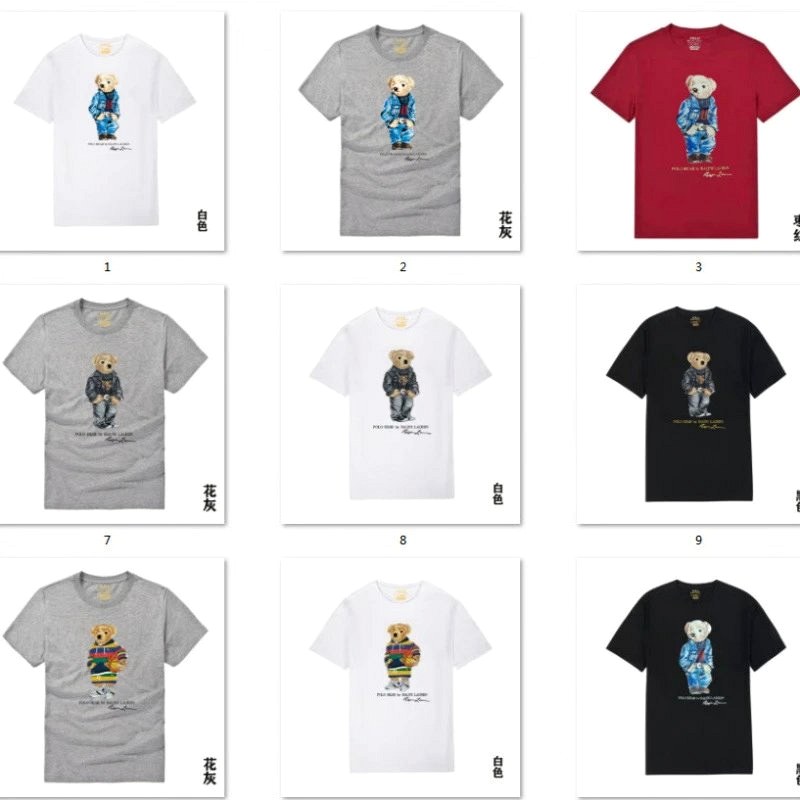
The bear-print Polo tee is the sort of $17.16 item that gets judged on a thumbnail: cute graphic, familiar branding, four colorways, sizes S–XXL. That is not how we test apparel. We ordered a Large in black and a Medium in heather grey through our shopping agent, logged $34.32 in item cost (the listing shows $17.16 against a struck-through $18.71), and then spent two hours at the Rotterdam measuring table with a tape, a digital caliper and a calibrated scale before any of it went near a washing machine.
This review is the audit of the parts a photo cannot settle: the collar rib, the hem, the print boundary, the stated 230 g fabric weight, and the size-chart gap that the listing never addresses.
What arrived, and what it weighed
The parcel was a single grey polymailer with both shirts bagged separately, no box, no tissue, no hangtag on the heather grey. The black shirt carried a small woven neck label and a printed interior size indication. No visible dye transfer between the two bagged shirts, and no loose threads in the bottom of the mailer — a small thing, but it usually predicts how the seams were finished.
On our calibrated scale the Medium came in at 216 g and the Large at 233 g. Neither figure verifies "230 g" as a fabric spec; GSM describes one square metre of greige cloth, while garment weight also includes collar rib, hems, labels and thread. What the numbers do tell us is that the fabric sits in the midweight 200–230 GSM band rather than the 140–180 GSM range typical of fast-fashion jersey, which is consistent with the listing. The hand feel agrees: enough body to fall straight from the chest, not so dense that it traps heat on a July afternoon.
Measurements, flat-laid
The listing states a 1–3 cm tolerance, which is honest but unhelpful without a reference chart. We measured the two shirts flat, unstretched, after resting them for an hour:
| Measurement | Medium (heather grey) | Large (black) |
|---|---|---|
| Half chest, pit to pit | 52.0 cm | 55.5 cm |
| Body length, high point shoulder | 68.5 cm | 71.0 cm |
| Shoulder, seam to seam | 45.0 cm | 47.5 cm |
| Sleeve, shoulder to cuff | 20.0 cm | 21.0 cm |
| Bottom hem width | 52.5 cm | 56.0 cm |
| Collar rib depth | 2.0 cm | 2.1 cm |
| Garment weight | 216 g | 233 g |
Those numbers describe a relaxed, boxy body with only 0.5–1.0 cm growth between sizes at the chest — a wide increment that makes the Medium and Large closer than most shoppers expect, and it is the single most useful thing we can hand you. If you sit between sizes and want the loose look the listing advertises, take the smaller one; the fabric has almost no stretch to bail you out if you size up into a shapeless fit.
The cut question we cannot close
Ralph Lauren sells its knit tops in Slim-Fit, Custom-Fit and Classic-Fit, and the differences are not cosmetic: Classic-Fit runs wider through the chest with longer sleeves and hem, while Custom-Fit is roughly an inch and a half slimmer across the chest. This listing names none of them, and the seller does not publish a measurement chart. Our Large measures closer to a Classic-Fit block than a Slim, but we are not going to convert a guess into a fact. Before ordering, ask the agent to flat-measure the chest and length of your actual size, and compare that to a shirt you already own.
Collar, hem and stitch density
This is where cheap tees usually give themselves away, and this one partly does. The collar is a 2.0–2.1 cm rib, single-layer, with a clean seam at the back of the neck and no puckering at the shoulder joins. Under the calipers the rib thickness was consistent to within 0.1 mm on both shirts. The hem and cuffs are double-needle finished at roughly 1.8 cm with a stitch count we measured at six to seven per centimetre — a respectable figure at this price, and the reason the hem has not curled after three cold washes.
Armhole joins are the weakest point. On the black Large we found one 4 mm section where the overlock bite sits slightly proud of the seam allowance, visible only when the sleeve is turned inside out. It has not worsened, but it is the kind of finish you accept at $17.16 rather than celebrate.
The print, under a 10× loupe
The bear motif measures roughly 20 cm across and sits about 8 cm below the collar rib. It is a digital print, as stated. At ten times magnification the colour edges show the faint dot structure you expect from digital output, with softness of maybe half a millimetre at the outline — invisible at arm's length, faintly visible on the black colorway where the light fabric edge can halo against the dark ground. After three cold washes inside out and line drying, we logged no cracking, no flaking and no colour shift on either shirt. The white colorway would be the honest stress test for dye bleed, and we have not run it.
Three washes: what changed
- Body length: −0.8 cm on the Medium, −0.5 cm on the Large. Inside the stated tolerance and expected for cotton jersey.
- Half chest: −0.5 cm on both. Not enough to change the fit.
- Hand feel: measurably crisper out of the dryer-free line dry than when new, softening again after an hour of wear.
- Labels: our woven neck label and printed interior marking are both intact. That is our sample, not a guarantee.
Buyers outside this listing have reported Ralph Lauren neck labels peeling after a first wash — including on a replacement shirt — and cotton tops stiffening and shrinking slightly over repeated washing even when washed cold without a dryer. We saw the stiffening; we did not see a peeling label.
That is the honest split. Our two shirts held up through three cycles, but the wider record on Ralph Lauren cotton is mixed enough that we would not promise label longevity past a season of frequent washing. If you machine wash hot or tumble dry, assume the shrinkage margin disappears.
Verdict
As a $17.16 summer tee, this is competent work: midweight cotton with body, a collar rib that survived our calipers, a hem that has not curled, and a print that shrugged off three washes. The bear graphic is the draw and it is executed cleanly, if not with the crispness of a screen print. What holds the score at 4.2 rather than higher is the missing fit information — an unnamed Ralph Lauren block, no measurement chart, and a 1–3 cm tolerance that could mean two very different shirts — plus an armhole finish we would call adequate rather than good. Order through an agent who will photograph a flat-laid chest measurement, and this is an easy yes at the price.