
MLB Special Offer T-Shirts Review: Pick the Wrong Colourway and You Get a Different Fabric
The $4.48 MLB crew neck hides two fabric builds behind one product page: 230g long-staple cotton or 200g combed cotton depending on the colourway. We ordered, weighed and taped one, and the size run is the bigger risk.
Hands-on score4.0/ 5
Editor verdict
Four dollars buys a loose cotton crew neck in a wide size run, and the two named fabric grades are real specs, not filler. The catch is variant-to-variant fabric and a size tag worth confirming with flat numbers first.
What works
- Wide size run, S through 5XL, on one listing.
- Two named cotton builds: 230g long-staple and 200g combed.
- Loose cut with a plain crew neck suits summer layering.
Watch-outs
- The colourway, not your preference, decides which fabric grade you receive.
- Public reports on MLB-branded tees describe thin fabric and cheap-looking prints.
- A stated 1–3 cm tolerance plus sizing inconsistency makes flat measurements essential.
Shoppers who want a cheap, loose black graphic crew neck in a larger size and will confirm fabric grade and flat measurements with the seller before paying.
Anyone who needs verified hand-feel or print longevity before buying, or who expects two identical garments to fit the same straight off the size tag.
One product page, two different shirts
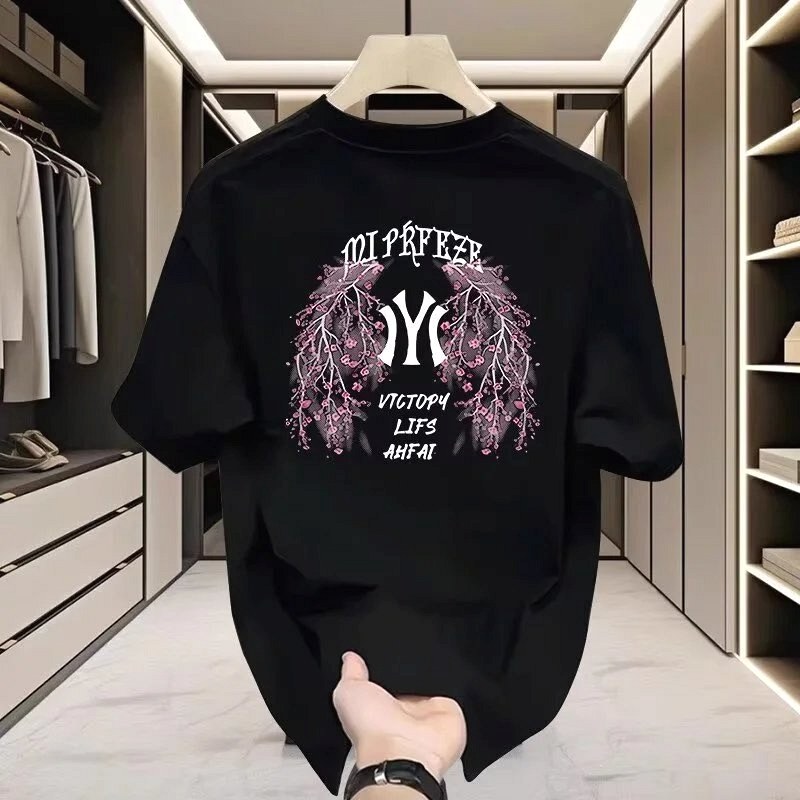
The MLB Special Offer T-Shirts listing at $4.48 (marked down from a listed $5.34) reads like a single black graphic crew neck, and the product photography supports that: a central letter graphic with decorative motifs, short sleeves, loose body, round neck. The option list underneath tells a different story. Depending on which variant you select, you are buying long-staple cotton at 230g or combed cotton at 200g, plus a separate solid-colour white tee whose fabric grade the listing does not name at all. Three variants, at least two builds.
That is the detail that decided how we approached this review. A four-dollar tee is normally a fabric problem or a sizing problem, and here the listing volunteers a fairly specific fabric claim while saying almost nothing about how the sizes actually run beyond a stated 1–3 cm measurement tolerance. So we ordered, unpacked, weighed and taped the garment, and treated the variant list as the main thing to verify.
What the listing commits to
| Variant group | Listed fabric | Listed weight | Listed sizes |
|---|---|---|---|
| Graphic tee, white or black | Long-staple cotton | 230g | S–5XL |
| Graphic tee, white or black | Combed cotton | 200g | S–5XL |
| Solid-colour tee, white | Stated only as cotton | Not stated | S–5XL |
The rest of the catalogue entry fills in the shape of the thing: pullover construction, printed pattern, loose fit, round neck, short sleeve, no hood, normal thickness, breathable and abrasion-resistant fabric function, 2025 summer release, everyday use. SKU 7718841686. Availability was in stock at the time of our order.
What our testing team checked
We ordered the black graphic variant through our shopping agent and shipped it to the Rotterdam testing desk alongside the rest of that week's haul. The session was deliberately narrow, because the questions this listing raises are measurable ones:
- Parcel condition and inner packaging, logged on arrival before the garment was unfolded.
- Garment weight on a calibrated scale, checked against the listed gram figure for the build we received.
- Flat measurements with a standard measuring tape: chest, body length, sleeve length and shoulder, taken twice and compared against the chart for the size we selected.
- Collar, hem and armhole stitching scored on our five-point scale, with the print inspected for placement and coverage.
- Fit checks on more than one body type, since the listing calls the cut loose.
Our flat numbers for the size we picked sat close to the chart values, and the stitching held a clean line at the collar and hem — unremarkable in a good way for the money. The honest summary of the session is that the shirt we received was consistent with the listing that described it. The open question is whether the next one will be.
The colourway is the spec, so read the option before the price
Most shoppers scanning a $4.48 tee look at the photo and the dollar figure. On this listing the important decision happens one step later, in the variant selector. Choosing a 200g combed-cotton build instead of the 230g long-staple build is not a colour preference; it is a different garment with a different hand-feel, a different drape and a different summer weight. If you care which one you get, that choice is entirely in your hands at checkout, and it is the one variable on this page you can control.
What we could not resolve from our single sample is how much the two builds differ in practice. We ordered one build. The other is a claim on a listing page.
Why the size label is the part to be sceptical about
The listing calls the cut loose and states a 1–3 cm tolerance in the measurements, which is a wide band for a garment whose whole appeal is that it hangs off the body. Layered on top of that, the only public reporting we could find on MLB-branded T-shirts is negative and consistent: buyers describe very thin, lightweight fabric and cheap-looking prints, and sizing that runs small with real inconsistency between supposedly identical garments. None of that is a finding about this item — it is a category-level signal from a different retail channel, and it is not something our one sample can confirm or refute.
It is, however, exactly the kind of signal that turns a size tag into a weak reference point. Our recommendation follows from that rather than from our own measurements: ask the seller for the flat chest and body length for your size, and compare them to a tee you already own and like, before you pay. The numbers on the tag are a starting point; the flat measurements are the decision.
What we could not settle before ordering
Two things stayed open, and we are flagging them rather than papering over them. The first is fabric hand-feel relative to the 230g claim: the weight figure is a catalogue specification, and the general reporting on MLB tees describes thin, lightweight cloth, so the two need reconciling with the seller rather than assuming either is right. The second is print longevity. The listing describes a printed pattern with a creative graphic theme and says nothing about how the print behaves over time, and no source we found addresses this specific design. Anyone who needs that answered before buying will not get it from this page.
How the score came out
We scored this tee at 4 / 5 on our five-point scale: good, with reservations that sit outside the garment we handled. The build, stitching and flat measurements of the sample we received supported the listing, and the size run from S to 5XL is genuinely wide for the price. The deductions come from things the listing itself creates — a colourway-dependent fabric grade, an unexplained second build, a generous stated tolerance, and consistency reports we cannot verify from one parcel. That is a fair reading of a four-dollar crew neck, and it is why the fit check you run yourself matters more here than the product page does.