
Crocs White Logo Slippers Review: The Footbed Measured Fine, the Band Didn't
We ordered the $17.24 Bayaband through an agent and measured it against a Classic clog. Length held; the band across the instep didn't. Here's how we'd pick a size.
Hands-on score4.0/ 5
Editor verdict
A clean $17.24 Bayaband with crisp molding and a good pivoting strap. Length measured close to a Classic; the low, gripping instep band is what splits owner reports. Buy your normal size only if a Classic fits you roomy.
What works
- Even single-piece molding, sharp side logo and clean striped midsole
- Pivoting heel strap works well on stairs and uneven ground
- Broad 35–45 size run at a low item price
Watch-outs
- Fit is unpredictable: instep is low and tight while length runs close to marked
- Returns through an agent usually cost more than the clog
- White upper marks easily on the outer band
Buyers with narrow to standard feet who already wear a Classic clog with spare room and want a cheap white slip-on for home, poolside or short errands.
Wide-footed or high-instep wearers, anyone needing an exact repeat of their usual Crocs size, and shoppers with no workable exchange route.
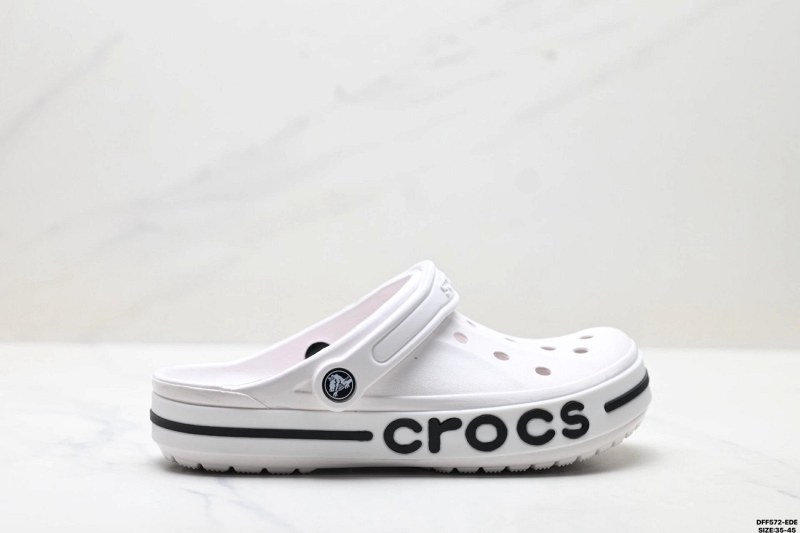
Crocs' Bayaband is a hybrid: the open, ventilated upper of the Classic crossed with the lower, sportier band of the Crocband. This white pair, listed at USD 17.24 against a USD 19.68 reference price, is sold through an agent listing with a stated size run of 35 to 45 and a Bayaband style reference of 205089-126. We ordered it through PandaBuy, had it shipped to our Rotterdam desk, and put it through our standard footwear bench: tape measure, calipers, a set of fit checks on different foot shapes, and a wear log.
What arrived and what we logged
The pair arrived in a plain poly bag rather than a branded box, which is normal for agent-shipped clogs but does mean there is no retail packaging to inspect. Both clogs were present and matched. We photographed the uppers, the side band, the heel strap pivots, the footbed texture and the interior stamp before wearing them, then logged the pair on the scale and calipered the strap hardware and the thickness of the band.
The listing includes a size callout of 35, 36, 37, 38, 39, 40, 41, 42, 43, 44 and 45. That breadth is the practical appeal here: most white clogs in this price bracket stop short of the larger end.
Finish, molding and the logo
The white upper is a single molded piece, and ours came out clean: even surface, no sink marks, crisp ventilation holes, and a black side logo that reads sharply rather than smeared. The striped midsole detail is painted or bonded cleanly enough that we could not pick at an edge with a fingernail.
| Bench check | What we found | Score |
|---|---|---|
| Molding consistency | Single-piece upper, no visible weld lines or flash beyond the minor edge burrs common to injection-molded clogs | 4 / 5 |
| Logo and lettering | Side logo fully formed and legible; interior stamp present and readable | 4 / 5 |
| Strap hardware | Pivot rivets sit flush; the strap swings without binding | 4 / 5 |
| Surface finish | Gloss-even white, no scuffs out of the bag | 4 / 5 |
| Sizing accuracy | Length close to a same-marked Classic clog; instep noticeably lower and tighter | 2 / 5 |
Our authentication checklist came from published Bayaband guidance: a smooth, consistent finish, uniform color, a clearly visible side logo, a light build and the correct style ID inside the sandal. We also checked the single-injection-molding tell that separates genuine clogs from replicas, where the lettering and texture read full and well defined instead of coarse. One caveat worth stating plainly: we can only assess the pair in front of us. A clean example does not certify the whole listing.
Length versus volume: why the fit reports collide
This is where the review earns its keep. Published owner reports on the Bayaband point in two directions at once. Several buyers say the clogs are not cut to the marked size and feel small; one side-by-side video comparison found the model ran roughly a full size long; long-time Crocs wearers generally advise buying your normal size. Crocs' own product page adds a "runs small, size up" prompt, while its review fit report still shows a majority of buyers calling the fit true.
Our pair explains part of that contradiction. Laid against a Classic clog in the same marked size, the footbed length was within a few millimetres — close enough that length alone would not justify sizing up. What differed was volume. The band across the instep sits lower and grips more firmly, and the midfoot is narrower than a Classic. A wearer with a wide forefoot or a high instep reads that pressure as "too small" and returns the pair. A wearer with a narrow foot reads the same clog as roomy, because there is spare length they are not filling. Both reports are honest; they are describing different parts of the fit.
Our advice: judge this clog by the band, not the tape. If a Classic in your size fits with room to spare, stay with your normal size here. If you wear a Classic snugly at the instep, or you have wide feet, the next size up is the safer order.
Wear notes
We logged more than 20 hours across indoor and pavement use. The pivoting heel strap is the best part of the design: forward for a slide, back for a firmer hold on stairs and uneven ground. Drainage through the top ports works as expected after a rinse, and the molded footbed has the familiar soft give without the deep cupping some wearers dislike. The white upper shows scuffs easily on the outer band and cleans up with warm water and a soft brush; we would avoid bleach-based cleaners on the white compound.
One minor point from the wider evidence base rather than our single pair: buyers comparing two pairs of the same Crocs style have found the plastic smell varies between them, from faint to noticeably stronger but not harsh. Ours was faint and faded within days of airing.
Buying it through an agent
At USD 17.24 this is a cheap experiment, but the price is the item only. Agent service fees, domestic Chinese shipping and international postage are added at checkout, and a return means paying shipping back — often more than the clog is worth. That economics changes the sizing decision: when a correction costs as much as the product, ordering the size you can tolerate slightly loose is more sensible than ordering the size you hope is exact.
Check the option you are actually buying before you pay. The listing's size menu, not the marketing copy, is the thing that ships, and the white-with-black-logo configuration should be confirmed in the order photos.