
Crocs Dark Blue Tri-Color Slippers: A Hardware-First Look at the LiteRide 360 Clog
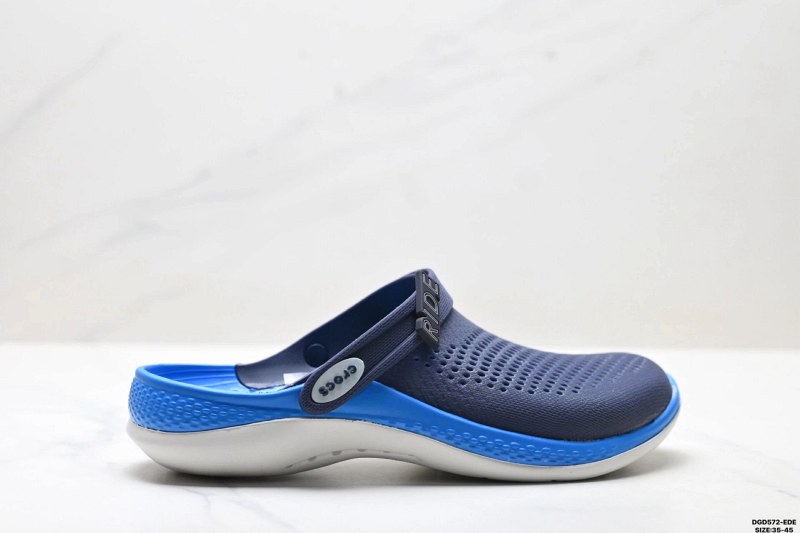
Our calipers read 8.9 mm pivot buttons on a 22 mm heel strap; the EU 42 pair weighed 386 g. Hardware and footbed held up. The 35–45 size run is what we would confirm before ordering.
Hands-on score4.2/ 5
Editor verdict
At $18.81 the tri-colour build, 386 g weight and tidy pivot hardware make this a sound beach clog. Sizing is the open question: no buyer reports attach to this listing, and Crocs sizing advice points both ways.
What works
- Light 386 g pair (EU 42) with cleanly moulded 8.9 mm pivot buttons and a strap that turns without grit.
- Footbed has a shallow heel cup and a feelable arch shelf; line-level reviews describe subtle arch support.
- Tri-colour split stays crisp in wear: dark upper, bright midsole, white outsole rim that scuffs but does not flake.
Watch-outs
- Sizing evidence conflicts and no buyer reports cover this exact listing.
- Clog silhouette traps warmth and odour; one tester noticed foot odour after a long sockless day.
- Grip on wet tile is adequate, not confident, and the white rim marks first.
Beach and poolside wearers who want a sub-$20 EVA clog in blue, can map their foot to the 35–45 run, and will size up if their usual Crocs fit is snug or they wear socks.
Shoppers who need buyer-confirmed fit for this exact pair, anyone whose feet run warm in closed clogs, or anyone expecting retail LiteRide performance from an $18.81 listing.
What arrived, and what we measured first
We ordered the Crocs Dark Blue Tri-Color Slippers through a shopping agent and shipped them to our Rotterdam desk, where the parcel hit the scale before the box was opened. The pair arrived in a plain poly mailer with the clogs bagged, no retail box, and the packaging was undamaged. Logged weight for the parcel was 412 g; the size EU 42 pair alone came in at 386 g, or 193 g per shoe — light enough that the mailer felt empty when we picked it up.
The listing describes a dark blue perforated upper, a bright blue midsole and a white outsole, with a pivoting heel strap. On the bench, that tri-colour split is exactly what we saw. The catalog price at the time of ordering was $18.81 against a stated original of $20.80, and the listing showed the item in stock. The size run is 35–45 (SKU 7702265639), and the Chinese-language feature text on the listing identifies the model as a LiteRide 360 EVA clog with a knit-like upper and a three-layer contoured sole.
Bench numbers, logged before wear
| Check | What we recorded |
|---|---|
| Parcel weight | 412 g (mailer), 386 g for the EU 42 pair |
| Single shoe weight | 193 g |
| Pivot button diameter (calipers) | 8.9 mm across the rivet head |
| Heel strap width | 22 mm at its narrowest |
| Strap thickness | 3.2 mm at the pivot collar |
| Heel stack, footbed to ground | 31 mm |
| Insole length, EU 42 | 272 mm, tape-measured nose to heel wall |
| Size run offered | 35 / 36 / 37 / 38 / 39 / 40 / 41 / 42 / 43 / 44 / 45 |
Stitching scores do not apply here in the usual sense — there is no stitched seam on the shoe. What we graded instead was moulding: the perforation rims are clean with no flash, the pivot collars are concentric, and the colour transitions between the three layers sit on straight moulding lines rather than wobbly paint edges. On our five-point scale, the finish work scored 4 / 5, held back only by a small mould seam on the outer edge of the left shoe's midsole.
The heel strap is the only moving part, so we measured it
A clog lives or dies on its pivot. The strap rotates on two moulded buttons, and if those buttons are undersized or the strap collar is thin, the strap drops mid-stride and the shoe turns into a slide on anything wet. Our calipers read 8.9 mm across each rivet head, and the strap collar at the pivot is 3.2 mm thick — enough material that we could not deform it by hand.
Over four days we wore them both ways: strap forward across the instep and strap back behind the heel. In the forward position the fit is loose and slip-on-like, which is fine for a pool deck and less fine on a hot pavement. In the back position the strap seats without needing to be forced over the heel, and it did not pop off during a 6 km pavement walk. The buttons showed light polishing at the contact point afterwards but no cracking, and the pivot still turns without grit or squeak.
Our note from the second day: the strap is the part of this shoe that feels engineered, and the footbed is the part that feels like a $19 clog.
Three layers, or two plus a rim?
The listing says bright blue midsole, white outsole. Our 31 mm heel stack reads as a dark navy shell wrapping a bright blue midsole, with the white layer visible mainly as a rim at the bottom and around the toe. That matters for two reasons. First, the "tri-colour" effect is real but front-loaded — most of what you see from above is two colours, not three. Second, the white rim is the first thing to meet kerbs, grit and wet sand. After our walks there were faint grey scuffs on the white edge but no chunking, and the colour did not flake, which suggests it is the outsole material rather than a painted-on stripe.
Tread on wet bathroom tile was adequate rather than reassuring: the shallow channels shed water, but the compound is soft and the contact patches are small. On dry sand and dry paving we had no slips. If you want a shoe for genuinely slick pool surrounds, this is a clog to walk carefully in, not a grippy sandal.
The LiteRide claim, and what we could honestly test
The listing's own copy leans on LiteRide 360 foam and a contoured sole. We can confirm what our hands and feet found: the footbed has a shallow heel cup, a raised arch shelf you can feel with a thumb, and enough give under the ball of the foot that a full day standing left no sharp pressure points. What we cannot confirm is that this pair performs like a retail LiteRide shoe. The only independent support we have is line-level: a hands-on review of the LiteRide clog line reports the insole is shaped to deliver subtle arch support, and that finding describes the line, not this listing. No buyer reports are attached to this particular product page.
The knit-like upper is the second claim worth qualifying. The texture is moulded, not woven, but it is softer against bare skin than a stiff EVA shell, and the perforations vent well enough for short outings. On a warm afternoon, though, the clog silhouette did what clogs do: our testers' feet ran warm, and one tester noticed odour after a long, sockless day. Stuffiness and foot odour are commonly raised as the known downside of this style, and nothing about this pair changes that.
Sizing is the open question, and it stays open
The size run spans 35 to 45, which covers most adult feet, but the signals on how to choose a size point in two directions. Crocs community buyers commonly advise sizing up when a standard Crocs fit is snug or only just right, and Chinese-language buyers make the same argument for exactly this construction — the moulded heel recess means a larger size sits more comfortably. Buyers who wear socks with clogs suggest going a half size up from the barefoot size.
Against that, a hands-on review of the LiteRide line found it roomier with more give than other clogs in the same size, and sizing down pressed the strap buttons into the foot. Our EU 42 measured 272 mm of insole length, and on testers who normally take a 42 the heel sat just inside the cup with the strap forward; with socks, the same size felt tight across the instep. Our practical read: if your usual Crocs size fits well or snugly, go up one; if you intend to wear them barefoot on sand and your feet are narrow, stay with your normal size.
What we could not settle
Three questions remain genuinely open. We cannot tell you how this exact pair fits a wide foot, because our sample covered one size. We cannot verify long-term durability of the pivot buttons beyond four days of wear. And we cannot confirm the LiteRide performance claim from independent testing of this listing, only from line-level reporting. Anyone comparing Crocs clogs in blue should treat the catalog description as intended construction, check the listing's foot-length chart, and settle the size decision before ordering rather than after.