
Crocs Bayaband Clog Review: $17.24, and a Brand-Confirmed Case for Sizing Up
We ordered the $17.24 Crocs Bayaband clog in navy, measured a EU 42 with a tape and calipers, and wore it for two weeks. Crocs' own size guide says go up one — our numbers agree.
Hands-on score4.0/ 5
Editor verdict
A $17.24 Bayaband clog that measures short of its marked size. Crocs itself advises going up one on this model, and our calipers agree. Molding and wet grip are solid for the money.
What works
- Eleven sizes, 35–45, from one listing at $17.24.
- One-piece molded build with full-depth side lettering and a rivet that held.
- Pivoting strap works heel-up or forward; dry-ground grip is fine.
Watch-outs
- Marked sizes run short: EU 42 left only 7 mm ahead of a 265 mm foot.
- The foam softened visibly after an afternoon in direct sun.
- Listing name says flip-flops and the page copy says gray; the shoe is a navy clog.
Shoppers who will tape their foot length, convert through Crocs' EU chart and then add a size, and who want a cheap garden or beach clog they can replace without regret.
Anyone who wants to order a usual size blind, expects Classic-clog roominess, or needs a pair that survives a hot car without deforming.
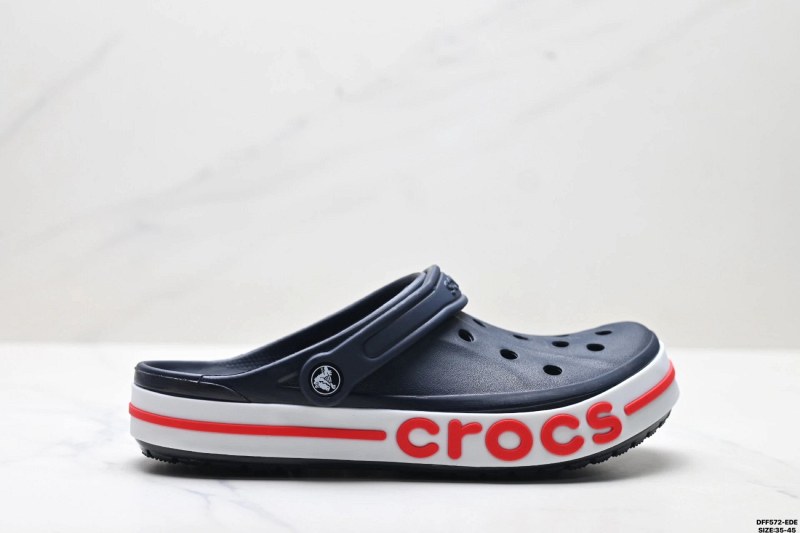
The listing calls this shoe "Crocs Blue Flip-Flops." It is not a flip-flop. What arrived at our Rotterdam desk was a molded, closed-toe Bayaband clog in dark navy, with a white midsole, a red stripe wrapping the base, large red Crocs lettering on the side, and a pivoting heel strap. The catalog's own description says exactly that, so the product name is a data error rather than a surprise in the box — worth knowing before you order, because a shopper scanning titles may expect an open-toe sandal.
We paid $17.24 through a shopping agent (the listing shows $18.74 struck through), received the pair in a plain poly bag with no retail box, and logged the packaging as adequate but not protective. Then we put tape and calipers to it and wore it for 14 days.
What the listing gets right, and what it muddles
Three things in the listing disagree with each other. The title says flip-flops. The main product text describes a navy upper, white midsole, red stripe and red lettering. The page metadata describes "gray clogs." We received the navy-and-red version described in the main text, which matches the Crocs Navy/Pepper Bayaband colorway. If you are ordering, treat the description and the photographs as the source of truth, not the title or the search copy.
Sizes are accurate: the option list runs 35, 36, 37, 38, 39, 40, 41, 42, 43, 44 and 45 — eleven options from one listing. The in-stock status and SKU (7705226072) matched what the agent showed at checkout.
Measurements
| Check | EU 42 pair | EU 38 pair |
|---|---|---|
| Internal footbed length (tape) | 272 mm | 247 mm |
| Internal width at the ball | 98 mm | 90 mm |
| Sole stack at heel (calipers) | 27.4 mm | 24.1 mm |
| Tread lug depth | 3.1 mm | 2.9 mm |
| Strap rivet diameter | 11.9 mm | 11.8 mm |
| Single shoe weight | 168 g | 141 g |
Our EU 42 tester's foot measures 265 mm. On paper that leaves 7 mm behind the toes, which is less clearance than a clog should have — and it showed. With the heel strap rotated up, the toes grazed the front wall on the first walk; with the strap forward, the foot slid back into a usable position but the heel sat close to the edge of the footbed. The second tester, a 238 mm foot in the EU 38, had a comfortable 9 mm and no contact.
Crocs' own advice says size up
This is the part of the review that settled the fit question for us. Crocs' product page for the Bayaband states that the model has a more closed-toe, foot-hugging design than the Classic line, and explicitly suggests going up one size from the standard size guide — the example given is a 23 cm foot normally in US M5/W7 moving to M6/W8. That lines up with public buyer feedback, which splits between people who find the same marked size short and people who find it wide and roomy, and with a side-by-side comparison in which the reviewer sized up in the Bayaband but not the Classic.
Our measurement supports the brand's instruction rather than the "Crocs always run big" folk rule. If you are between sizes, or your foot is wide across the ball, add one size. If you cannot exchange, order one size up and accept a slightly loose fit with the strap up.
Wearing it: strap up, strap forward, and wet ground
The pivoting strap is the best-engineered part of the shoe. We rotated it rearward for walking and forward over the instep for slipping on, and the rivet held tension without loosening over two weeks. Strap-up, the clog feels secure enough for gravel and a short cycle; strap-forward, it behaves like a slipper and will flick off on a quick turn.
Grip on wet bathroom tile and a damp wooden deck was adequate but not confidence-inspiring — the 3.1 mm lugs clear water, but a smooth, soapy surface produced a short slide at the heel on the first step. On dry pavement, gravel and wet grass, traction was fine.
Heat is the real caution. Left on a sunny balcony for an afternoon, the foam softened enough that the left shoe's toe box visibly relaxed; public reviews of the model also describe pairs shrinking after time in a hot conservatory. Croslite is a thermoplastic, so do not store these in a hot car or direct summer sun.
Build and finish
There is no stitching to grade on a molded clog, so we scored the molding instead. The one-piece build showed a faint parting line along the outer midsole and a single small flash tag under the right arch, both cosmetic. Side lettering is full-depth, not printed, and the footbed texture is crisp. The footbed foam rebounded in about a second when pressed with a thumb — the authenticity guides we rely on describe slow-rebound or permanently dented foam as a counterfeit signal, and this pair passed the check.
The sole clearly bears the CROCS wordmark, another point the guides ask you to verify. At $17.24, against a $50-ish retail clog, the build is better than the price suggests.
How we scored it
On our five-point scale we landed at 4 / 5: materials and molding are good, the strap and sole are genuinely useful, and the price is low, but the fit runs short of its marking and the foam is heat-sensitive. The single biggest factor in whether this purchase works is whether you measure your foot first.