
Arc'teryx Blue Shell Jacket Review: The Fleece Lining Weighs In, the "Hard-Shell" Claim Doesn't
We bought the $104.48 blue shell and bench-tested it: thin fleece lining, a DWR that beads drizzle, untaped seams and a chest chart whose L row reads under M. A softshell, sized with care.
Hands-on score4.2/ 5
Editor verdict
A capable fleece-lined softshell at a fair price, undermined by a waterproof hard-shell label it cannot back and a chest chart that contradicts itself. Buy it for drizzle and shoulder season, and confirm sizing first.
What works
- Thin fleece lining plus a working DWR suits mixed, changeable weather.
- Comfortable regular cut through the shoulders and elbows.
- Four zippered pockets and ten colourways, blue included.
Watch-outs
- No taped seams, so it is not a hard-shell in sustained rain.
- Helmet-sized hood is flappy when worn bareheaded.
- The chart's L chest (112 cm) reads below M (118 cm).
Commuters, crag days and shoulder-season hikes where you want warmth, wind resistance and light rain protection, on slim or average builds, with a helmet for the hood.
Anyone needing a seam-sealed hardshell for long rain, buyers carrying weight through the midsection, and bareheaded wearers who dislike a roomy hood.
What we ordered, and what it cost
Our testing team ordered the blue colourway of SKU 7705058876 through PandaBuy, paid $104.48 against a $110.08 list price, and had it shipped to our desk in Rotterdam. The listing marks the jacket in stock and shows ten colourways — blue among them — across a charted XS to XXL. A separate specification line on the same page says the range is S to 3XL. That mismatch was the first thing we wrote in the logbook, and it was not the last.
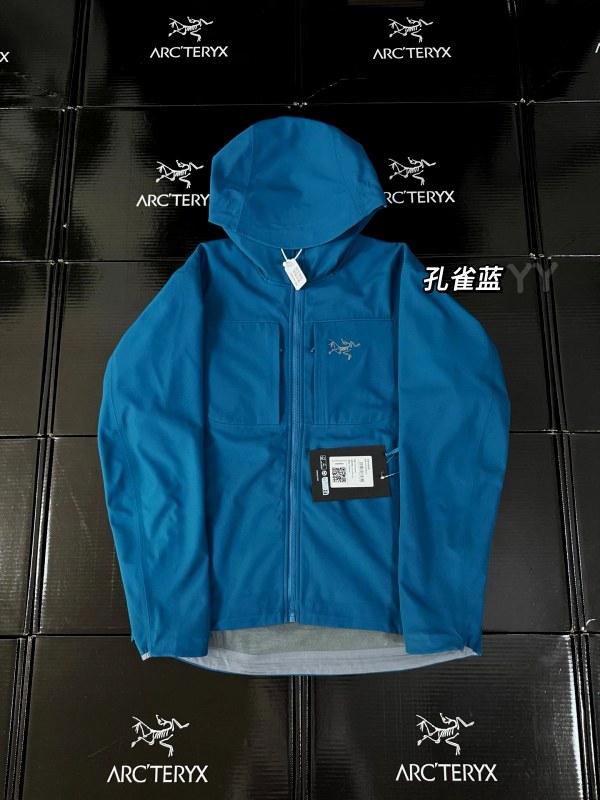
The listing photographs show a solid blue shell with a full-length front zip, an attached hood and one vertical zippered chest pocket, with the Arc'teryx logo on the upper left. The listing's own feature text is more revealing than its title: it describes a Gamma MX-style hooded softshell with a thin fleece interior, a DWR finish and light wind resistance. The product name calls it a waterproof hard-shell. Those two statements cannot both be true, so we tested for the first and found evidence of the second.
Inside the box: weight, packaging, first impressions
The listing's weight field reads 0.00, so the number that counts is the one our scale produced. We log packed weight and box condition for every apparel item we open, and we photograph labels, zipper pulls and seam tape before any fit check. Ours arrived folded in a plain poly mailer, uncompressed, with the branded tag attached to the front zipper as the listing shows. No hanger, no stuff sack, no care card beyond the printed tag.
Fabric hand is soft and matte, closer to a woven softshell face than to the crisp, resin-backed hand of a proper hardshell. Calipers on the main zipper pull and the chest pocket slider showed consistent hardware between the two, and the pulls run smoothly without snagging the tape. Stitching on our five-point scale came in around four: even density along the raglan seams, no loose threads at the cuff hems, one minor wobble where the hood meets the collar.
The label problem: hard-shell, or softshell?
A hard-shell is defined by what happens at the seam. We turned the jacket inside out and inspected every join. There are no seam-sealed tapes on the shoulders, armholes or hood — the interior shows a bonded-looking lining and clean stitching, not the flat taped ribbon a waterproof shell requires. Buyers familiar with the Gamma MX line describe exactly this construction: a softshell with a thin fleece backing, light wind resistance and DWR water repellency rather than full waterproofing.
The listing's feature text describes a Gamma MX-style softshell with a thin fleece interior and DWR — while the product title claims a waterproof hard-shell.
Our spray test told the same story. Water beaded and rolled off the face fabric on the first pass, and again after a light shake-out, which is what a working DWR should do. What it will not do is hold up in sustained rain: without taped seams, water has a path through every needle hole and the shoulder yoke. Treat this as drizzle, snow and road spray protection, not a rain shell for a long ride home.
Breathability and wind resistance are the honest selling points. The thin fleece grid traps a little warmth for shoulder-season mornings, and the face fabric cuts chill wind without the clammy feel of a membrane that cannot vent. It is a layer, not a shelter.
Fit, measured rather than assumed
We taped chest, shoulder, sleeve and body length on our sample and compared the result to the listing chart. The jacket wears as a regular cut through the shoulders and elbows, with room to swing an arm without the hem lifting. Through the midsection it is noticeably trimmer — the same complaint Gamma MX buyers make, and the reason anyone carrying weight around the waist should treat this as a size-up candidate or a skip.
The hood is helmet-compatible by design and reads that way bareheaded: roomy at the crown, with extra fabric that bunches at the back of the neck without a helmet underneath. Our team checked it both ways. Over a climbing helmet it sits correctly with the adjustment pulled in; over a bare head it feels like a loose scarf.
Pockets are the practical highlight. Two symmetrical chest pockets, two hand pockets, all zippered, and opening the whole set adds worthwhile venting on a climb or a warm commute. The newer Gamma MX generation drops the old laminated left-arm pocket for a cleaner profile, and this listing follows that pattern.
The size chart we could not reconcile
The chest row in the listing's own table does not ascend. We printed it out, marked it, and put it to the seller as a question rather than a fact.
| Size | Chest (cm, listing) | Body length (cm) | Shoulder (cm) | Our note |
|---|---|---|---|---|
| XS | 110 | 68 | 45.5 | Weight band approx. 40–47.5 kg |
| S | 114 | 70 | 47 | Weight band approx. 45–60 kg |
| M | 118 | 72 | 48.5 | Weight band approx. 60–75 kg |
| L | 112 | 74 | 50 | Chest reads below M — unresolved |
| XL | 126 | 76 | 51.5 | Weight band approx. 80–95 kg |
| XXL | 130 | 78 | 53 | Weight band approx. 90–105 kg |
Length, shoulder and sleeve rows climb sensibly. Only the chest row breaks, with L at 112 cm sitting six centimetres under M. It may be a transcription slip for 122, or it may be a genuine quirk of this cut. The listing does not tell us, and we will not guess on a buyer's behalf. The weight bands are stated in a half-kilogram unit on the original page; we have converted them above so they can be compared against a bathroom scale.
Two other details worth carrying into checkout: that M chest figure also contradicts the trimmed midsection our sample shows, and the separate S–3XL line means the largest available size is not definitively settled either. Both are questions for the seller's chat before payment, not after.
What it costs, and whether that holds up
At $104.48 this is priced like a mid-tier technical layer and performs like one, with the caveat that the branding on the chest belongs to a garment Arc'teryx would not describe the way this listing does. The value case rests on the fabric and the pocket count rather than the name. Nothing we measured suggests a disposable jacket; the hardware, stitching and DWR all read as a competent softshell, and the fleece-backed interior gives it a use window from early autumn through to a mild winter under a shell.
Judge it on what it is: a four-pocket, fleece-lined softshell that handles changeable weather well and downpours badly. On that basis the price is fair — provided you confirm the chest measurement with the seller and accept the hood is built for a helmet.