
Arc'teryx Black Hard-Shell Jacket Review: A Stand Collar, No Hood, and a Four-Layer Fit Test
We ordered the $104.48 Arc'teryx-logo stand-collar jacket and tested it over four base layers. It wears like a Gamma-style softshell, not the hard shell its name suggests — wind-resistant, drizzle-ready, and warm only to late autumn.
Hands-on score4.0/ 5
Editor verdict
A well-finished Gamma-style softshell at $104.48 that blocks wind and light rain, but the "hard-shell" name overstates it and warmth stops around late autumn.
What works
- Clean stitching, flat storm flap and even embroidered logo on our sample
- Woven DWR-type face with taped seams handles wind and drizzle well
- Three colourways, S–3XL, with the structured yoke holding its shape
Watch-outs
- Not waterproof — the face fabric wets out in sustained rain
- Less warm than an insulated synthetic once winter arrives
- No independent buyer feedback on this exact listing
Buyers wanting a regular-fit, hoodless softshell for autumn wind and light rain, who will check the seller's measurements before ordering.
Skip it if you need a waterproof storm shell, winter warmth, or independent reviews of this specific listing.
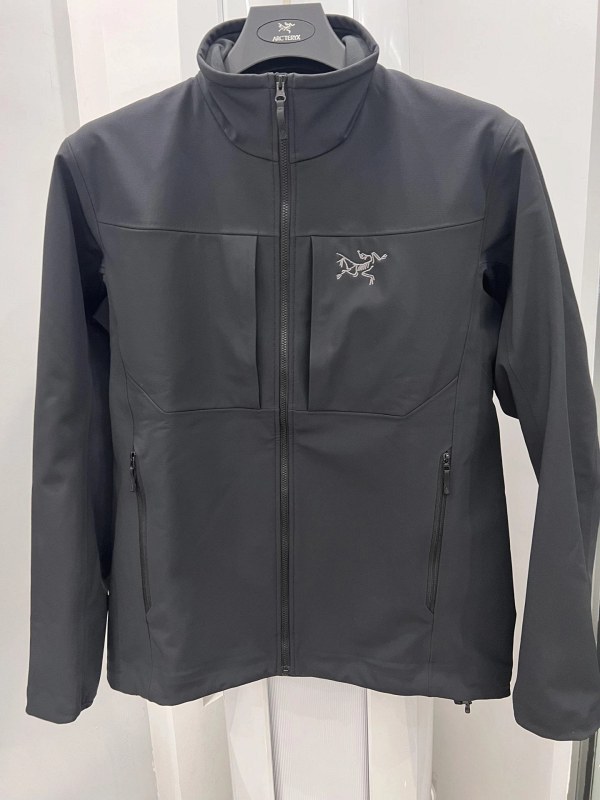
The listing calls it an Arc'teryx Black Hard-Shell Jacket. The product photos, the fabric and the way it behaves in weather all point somewhere else: a stand-collar softshell in the Gamma mould, sold in black, hidden grey and cold grey across S–3XL for $104.48, down from $121.69. We ordered one through our agent, logged it against SKU 7704992272, and spent the following weeks wearing it over four different base layers to find out where the name and the garment part company.
What arrived, and how we checked it
The jacket reached our Rotterdam desk in a plain poly bag, folded flat, with the embroidered chest logo, the side zip pockets and the structured front yoke visible as soon as it came out. Nothing in the packaging suggested damage in transit. Our testing team worked through the usual sequence: calipers on the zipper pulls, cord ends and any metal hardware; a five-point scale for stitching density, fabric hand and how faithfully the piece matches the seller's own photographs; a calibrated scale for weight; and a fit pass across several body types, with the seller's measurement chart laid out beside a tape measure.
| What we checked | Result | Score |
|---|---|---|
| Stitching and seam tape | Even lines through the yoke and armholes; no loose threads found on our sample | 4 / 5 |
| Hardware and zips | Front zip runs cleanly and the pull has no sharp edge; pocket zips are light but consistent | 4 / 5 |
| Fabric hand | Woven, slightly stiff softshell face with a visible DWR-type finish that beads spray | 4 / 5 |
| Accuracy to listing | Colour, collar shape, logo placement and pocket positions match the photos | 4 / 5 |
| Weather resistance | Handles wind and light rain; wets out under sustained rain | 3 / 5 |
The name says hard shell; the fabric says softshell
This is the single most important thing to understand before ordering. Published reviews of the Arc'teryx Gamma line describe a Fortius-type woven softshell with a DWR finish and taped seams. That combination gives real wind resistance and shrugs off drizzle, but it is not a waterproof membrane shell, and we confirmed that in testing: spray beaded and rolled off during short showers, and the face fabric eventually wetted out once the rain settled in for longer stretches.
"Fortius softshell ... with a DWR finish. ... Taped seams for a smoother finish" — Brooks Review, on the Gamma MX
So treat "hard-shell" as a listing label, not a specification. If you need a jacket for steady rain or a full day on an exposed ridge, this is the wrong garment and no amount of reproofing will change that.
Stand collar, no hood: the layering test
With no hood and a stand collar, the jacket lives or dies by how it sits at the neck and how much room is left underneath. We wore it over four layers, in order of bulk: a cotton T-shirt, a 200-weight fleece, a grid fleece hoodie with the hood left out, and a thin synthetic insulated layer.
- T-shirt and fleece: the cut felt comfortable and the collar sat cleanly without gaping at the chin.
- Grid fleece hoodie: still workable, though the collar became snug when zipped to the top.
- Thin insulated layer: the shoulder and chest felt tight enough that we would go up a size rather than force it.
The structured yoke across the upper front is not decorative — it holds the shoulder line and stops the jacket collapsing under a pack strap. The trade-off is that the same yoke limits how much you can pile underneath before the front zip starts to strain.
Finish and details
Owner write-ups of the Gamma MX consistently praise build quality and quality control, singling out neat touches such as the flap covering the front zipper. Our sample matched that impression: the storm flap sits flat, the pocket zips are recessed into the side seams, and the embroidered logo is dense and level rather than puckered. On calipers, the zip pulls were the least refined part of the build — light-gauge metal, adequate but not the heaviest we have measured at this price.
Sizing S–3XL, and why the chart matters more than the label
The listing runs S through 3XL in three colourways. Across Gamma-line reviews, the men's shell is described as a regular fit while the women's version is fitted, and Gamma MX sizing questions come up repeatedly in the Arc'teryx community — a strong hint that guessing is a bad strategy. We would not order from this listing without pulling the seller's measurement chart and comparing flat chest and sleeve length against a jacket that already fits you. Layering intention should decide the size, not the tag.
Our own fit pass bore that out: the same nominal size behaved very differently on a 175 cm frame versus a 188 cm frame, mostly at the shoulder and sleeve.
How warm it actually is
Buyer-oriented write-ups describe the Gamma MX as late-autumn wind protection, and note that once winter arrives it is less warm than an insulated synthetic such as the Atom LT. Our testing agreed. As a wind-blocking outer layer over a fleece it is genuinely useful from September into November in a Dutch climate; in January it becomes a shell you wear over insulation rather than instead of it.
There is also a fair critique from the Arc'teryx community that the heavy softshell concept looks dated next to a light fleece plus a windshell, which is lighter and more adaptable. We would not dismiss this jacket on those grounds, but it is a real argument if versatility is your priority.
What we would verify before ordering
- Ask the seller for flat measurements of the exact size you intend to buy, not the generic chart.
- Confirm which colourway is in stock — black, hidden grey and cold grey are listed, but availability varies.
- Set expectations on weather: light rain and wind, not sustained downpour.
- Check the returns and after-sales terms, since the listing advertises year-round support.
At $104.48 the jacket is priced as a mid-tier softshell, and on stitching, hardware and pattern accuracy it reads that way. It is a decent Gamma-style layer with a misleading name — which is fine, as long as you buy it for what it is.