 Von Marcus Bell
Editor-in-Chief
Von Marcus Bell
Editor-in-Chief
Thom Browne Knitwear Review: Fall/Winter Layering Guide
## The Fall/Winter thom browne Knitwear Shopping Task This Article Solves If you're looking for a [thom browne](https://fashion-reps.net/brand/thom-browne) knit for smart-casual office wear in fall and winter, what you really need to judge isn't the brand name on the page or a few retouched photos, but whether the product page provides enough evidence to support decisions about style, color, size, material, and details. This article's task is to help you build a verifiable record of page evidenc
Redaktionsnote 4.2 / 5
The Fall/Winter thom browne Knitwear Shopping Task This Article Solves
If you're looking for a thom browne knit for smart-casual office wear in fall and winter, what you really need to judge isn't the brand name on the page or a few retouched photos, but whether the product page provides enough evidence to support decisions about style, color, size, material, and details. This article's task is to help you build a verifiable record of page evidence before paying, and distinguish between information already shown and what still needs to be confirmed with the seller. 🧭
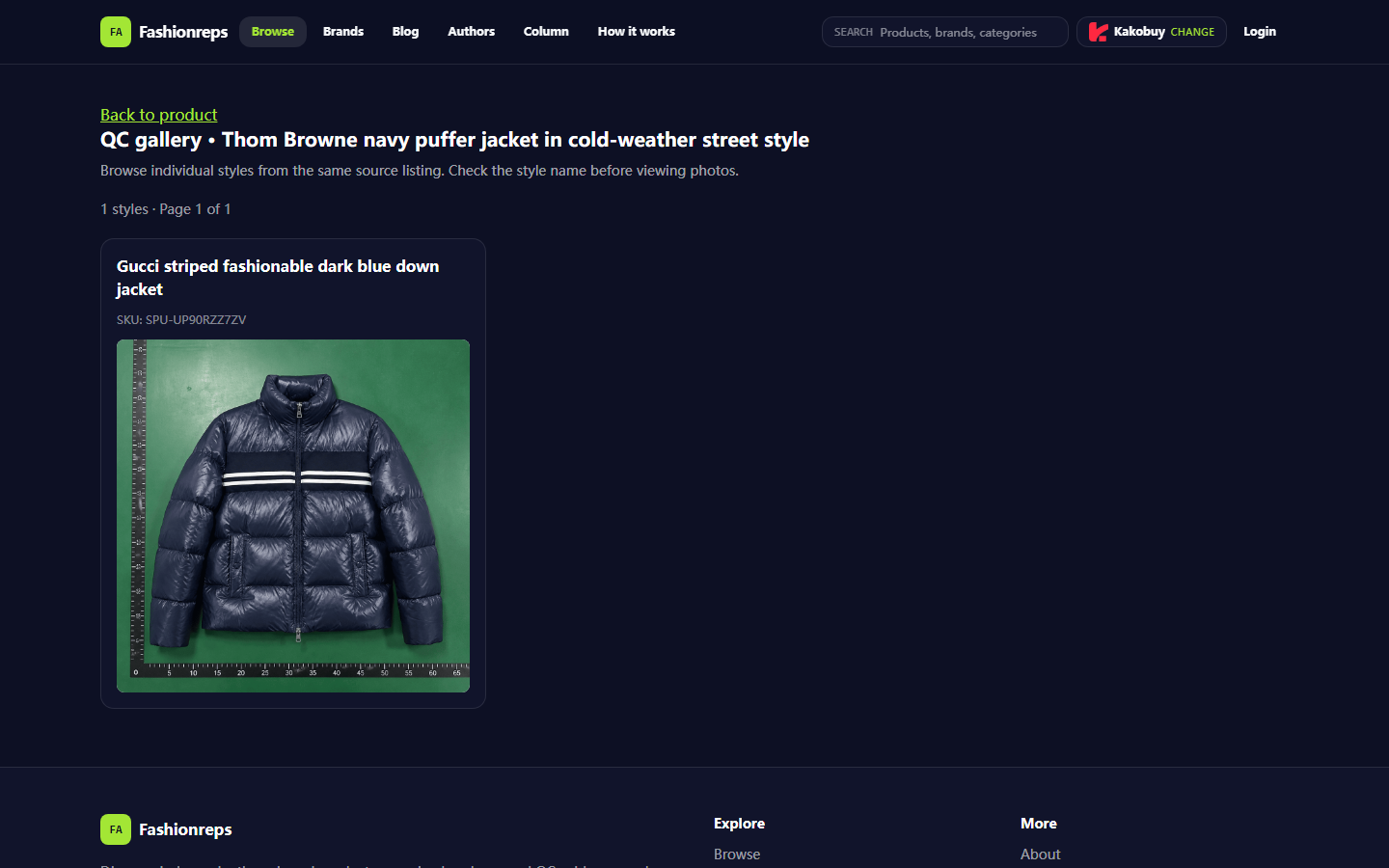
This article does not treat unprovided prices, stock, material composition, warmth, or wearing experience as facts. The currently verifiable image record actually corresponds to a navy down jacket QC page, not a knit, so it cannot be used to prove the knit's thickness, feel, fit, or workmanship. The following inspection method applies when you open a specific knit product page for secondary verification.
Check Style, Color, Size, and Material Labels on the Product Page
First record the page's original information; don't judge based solely on thumbnails. It's recommended to save the following separately: product name, seller SKU, color options, size options, size chart, material composition, page update time, stock status, and main product and detail images.
Pay special attention to the difference between "color name" and actual color difference. Navy blue, dark blue, gray-blue, or black-blue may look similar on different screens, but the effect for workwear styling is not the same. If the page only says "blue" without color swatches or natural light photos, mark the color as to be confirmed, rather than directly assuming it's classic navy.
For sizing, prioritize actual measurements like body length, chest width, shoulder width, and sleeve length, and compare them with your commonly worn shirts or jackets. Don't just rely on S, M, L or so-called "true to size." Knit fabrics may have stretch, and measurement methods can affect results; it's best to confirm whether the page states flat lay measurement and error range. 📏
Material information must come from the composition list, not from descriptions like "wool-like feel," "high yarn count," or "soft and warm." If the page doesn't list fiber percentages, record it as "material not sufficiently described," and don't infer it as wool, cashmere, or a blend.
Visible Evidence for Collar, Cuffs, Hem, and Pattern Details
Key evidence for knits is usually concentrated in four areas: collar, cuffs, hem, and chest or sleeve patterns. Each area should have at least one clear close-up without severe glare or obstruction.
For the collar, observe rib width, whether the edge is flat, whether seams are twisted, and whether the pattern transitions naturally at the collar. For cuffs and hem, check rib density, whether edges are loose, and whether there is obvious pilling or loose threads. For patterns, verify position, scale, color, and left-right symmetry; don't mistake shadows in low-resolution images for embroidery or knit texture.
The current image record shows a down jacket QC page and cannot serve as knit detail evidence. To avoid misleading, this image is only an example of page evidence boundaries, not representing the knit reviewed in this article:

If the knit page lacks close-ups of collar, cuffs, or pattern, it's recommended to write "details not verified" in your order notes and request additional images before submitting the purchase. 🔍
Layering Fit with Shirts, Trousers, and Outerwear
The key to fall/winter workwear is not whether a single piece looks eye-catching, but whether layering maintains mobility and visual order. When the knit is thin, pair it with a shirt with a crisp collar; when the fit is wide or the knit is thick, leave room in the outerwear chest and armhole.
| Styling Scenario | What to Confirm on the Page | What Cannot Be Judged from Photos Alone |
|---|---|---|
| Indoor office | Body length, collar shape, whether cuffs are easy to roll | Actual stuffiness, tactile feel |
| Layering over shirt for commute | Chest width, shoulder width, sleeve length, hem ease | Wrinkling after prolonged activity |
| Pairing with trousers | Color, pattern proportion, overall silhouette | Fabric drape and static |
| Layering under jacket or coat | Shoulder thickness, armhole space, body length | Actual warmth, compression deformation |
If the page only shows the knit worn alone without layering references with shirts or jackets, choose based on actual measurements with extra room, not by copying model proportions. Darker colors and bold patterns require confirming pattern placement and potential clashes with trouser colors.
Differences Among Commute, Indoor Office, and Short Trips
For indoor office, focus on collar comfort, cuff mobility, and ease of layering with shirts; for daily commute, also consider outerwear accommodation, backpack friction areas, and whether the hem rolls up easily; for short trips, check whether folding causes obvious wrinkles and whether the page provides care instructions.
These judgments must be based on visible information. If the product page doesn't describe thickness, weight, warmth rating, or care, list them as unknown. Don't claim a knit suits severe cold just because it looks thick; don't infer it won't show wear just because it's dark. ❄️
How to Record Community Feedback vs. Product Page Facts in Separate Columns
Community discussions can help identify common questions, but they cannot replace verification on the current product page. It's recommended to split information into two columns: one for what the product page explicitly states, the other for pending questions raised by community users, such as size deviations, pattern placement, seller response speed, or batch differences.
Don't turn one user's subjective review into a universal conclusion, and don't summarize a partially read discussion as "most buyers approve." If comments are incomplete, replies are collapsed, or the page is inaccessible, mark it as partially read and recheck before ordering.
Boundaries of Unstated Warmth, Thickness, and Feel
Page evidence can support appearance and labeling information, but usually cannot alone prove actual touch, breathability, warmth, pilling resistance, or long-term washing performance. Photos also cannot reliably judge knit density and weight unless the page provides clear fabric close-ups, weight, composition, and measurement instructions.
Therefore, purchase decisions can be divided into three tiers: when information is complete, proceed to size and price comparison; when partially complete, first request missing evidence from the seller; when key information is missing, postpone payment. This sequence is more reliable than quick ordering based on brand name or promotional language. ✅
Pre-Purchase Checklist for thom browne Knitwear and Next Steps
Confirm each item before ordering:
- The product name is indeed a knit, not a jacket, down jacket, or other outerwear.
- Color options match page images, and note color difference risks that need seller confirmation.
- Size chart includes actual measurements and has been compared with your existing clothing dimensions.
- Material composition is clearly stated, without treating marketing adjectives as fiber information.
- Collar, cuffs, hem, and pattern positions all have clear detail images.
- The page does not mix model photos, QC photos, or other product images as evidence for the current item.
- Unstated thickness, feel, warmth, and durability remain unknown.
- Save product page screenshots, seller replies, and verification dates for later review.
The current record shows that the provided QC image does not match the target knit, so specific product quality cannot be confirmed. The next step is to return to the target product page and complete evidence for style, color, size, material, and details; if the seller cannot provide key images or measurements, the safest action is to postpone purchase rather than fill gaps with speculation.
Article Image
